Wednesday, July 3, 2013

Best of intentions -- The Minnesota State Public School for Dependent Children

"There can be no keener revelation of a society's soul than the way in which it treats its children."
                                                       Nelson Mandela

   The State School for Dependent and Neglected Children of Minnesota was created with the best of intentions: to take children out of the poorhouses and workhouses, feed them, educate them, and find adoptive families for them.  Built in 1895 on 329 acres outside the small town of Owatonna, the State School and grounds are majestic and peaceful. A tour is narrated by the voice of an elderly man who grew up a "State School kid".
The Administration Building sits atop the hill overlooking the town.  Behind it are the cottages and other buildings, the farm, electric plant, hospital, and cemetery.  It now houses a small museum depicting the history of the orphanage.  Once it held an auditorium and the dining rooms where 500 children and workers ate all their meals.
 
In memory of the 12,000-15,000 (to me this is stunning, considering the population of Minnesota at this time) children who called it home, this sculpture looks out over the rolling front lawns.

   Many, if not most, of the children were not true orphans; they had one or more living parent who couldn't take care of them and earn a living at the same time, came from an immigrant family that had more children than it could house or feed, or there was severe physical or mental illness.
 
Children were housed in "cottages" by age and sex.  Each cottage had a matron dressed in a white nurse's uniform who oversaw the children and meted out corporal punishment for rule infractions.  There were playgrounds, pools, and a gymnasium for the 500 who lived there at a time.


Babies were attended by nurses in what was advertised as a completely sanitary environment.  Sadly, many died of "failure to thrive" from lack of love and touch.  (Click on photos to see details.)


   Each cottage had a front room, where children were never allowed, except sometimes at Christmas.
    The pillows were just for show and not to be used.  They were stored in the closets for the night.
 
   The cottage basement is where the children spent their indoor lives.  They entered and exited through a door in the basement and went upstairs only to go to bed at night.

   Each child had a chair where he sat and waited for the various activities of the day.  He dressed on his chair.  He was punished on his chair.  A little bag hung on the back of each chair with that child's possessions.
   The institution included a farm that raised all the food for the children, an elementary school, electrical plant, greenhouse, kitchen, bakery, shoe repair, barber shop,  and butcher shop, and the children worked in all these, plus did the cleaning and maintenance of the grounds. Most of the children were trained in these skills and then indentured out into the farms of Steele County and the wealthy homes of Minneapolis and St. Paul.  Some were fortunate in finding good placements, but most were sadly misused and overworked, according to their memoirs.
 
198 little graves, unmarked until 1993, stand on a hillside behind the school.
 
   A memorial walkway leads to and from the cemetery.  Some of my sadness went away when I read the inscriptions and realized that many of the children found love and a family after they were grown.
 
   The school closed as an orphanage in 1945 and became a home and school for the developmentally disabled, which continued until 1970.  Many of the old buildings are still in use for other purposes.  The administration building and Cottage 11 are open to the public as a museum.
 
   My grandpa was an orphan in Minnesota in the early 1900s.  I don't know that he ever spent time in an orphanage, but he was shuttled among relatives who didn't want him and taken out of school in the third grade to work and "earn his keep."  He had a hard and sad life as a child, with many of the same memories of the man who narrated this tour.  Happily, he, too, became part of a family who loved him very much, including me. 


Tuesday, July 2, 2013

Saturday, June 29, 2013

"Jewel Box of the Prairie"

   This is the story of the pairing of the unusual circumstances of two unusual men which resulted in an architectural treasure in a small town on the prairie in Minnesota.  The Farmers' Bank stands on the town square of Owatonna, Minnesota.
Simple square shape with vaulted stained glass windows and arch within a square.

   Carl Bennet's dad owned the Farmers' Bank in Owatonna, Minnesota. Son Carl's interests tended toward art and music, not banking, but, a dutiful son, in 1893 he graduated from Harvard and returned to Owatonna to take over the bank.  It was pretty unusual for those days in rural Minnesota for a young man to have a Harvard education, let alone an interest in the arts. 
Huge murals depict life on the prairie
 
   Carl agreed to run the bank, but he still had some creative ideas in his head.  He felt that the bank did not give the proper impression of solidness and service in its present building and set about finding an architect with a vision.
Clock is above the tellers' windows, against a prairie sky mural.
   The second unusual set of circumstances involves the legendary architect Louis Sullivan, the "father of skyscrapers" incorporating that new building material--cheap steel, mentor to young Frank Lloyd Wright.  Sullivan over the course of his career designed many of Chicago's famous buildings. So, why would the "father of skyscrapers" agree to design a small bank out on the prairie of Minnesota?  
 
  
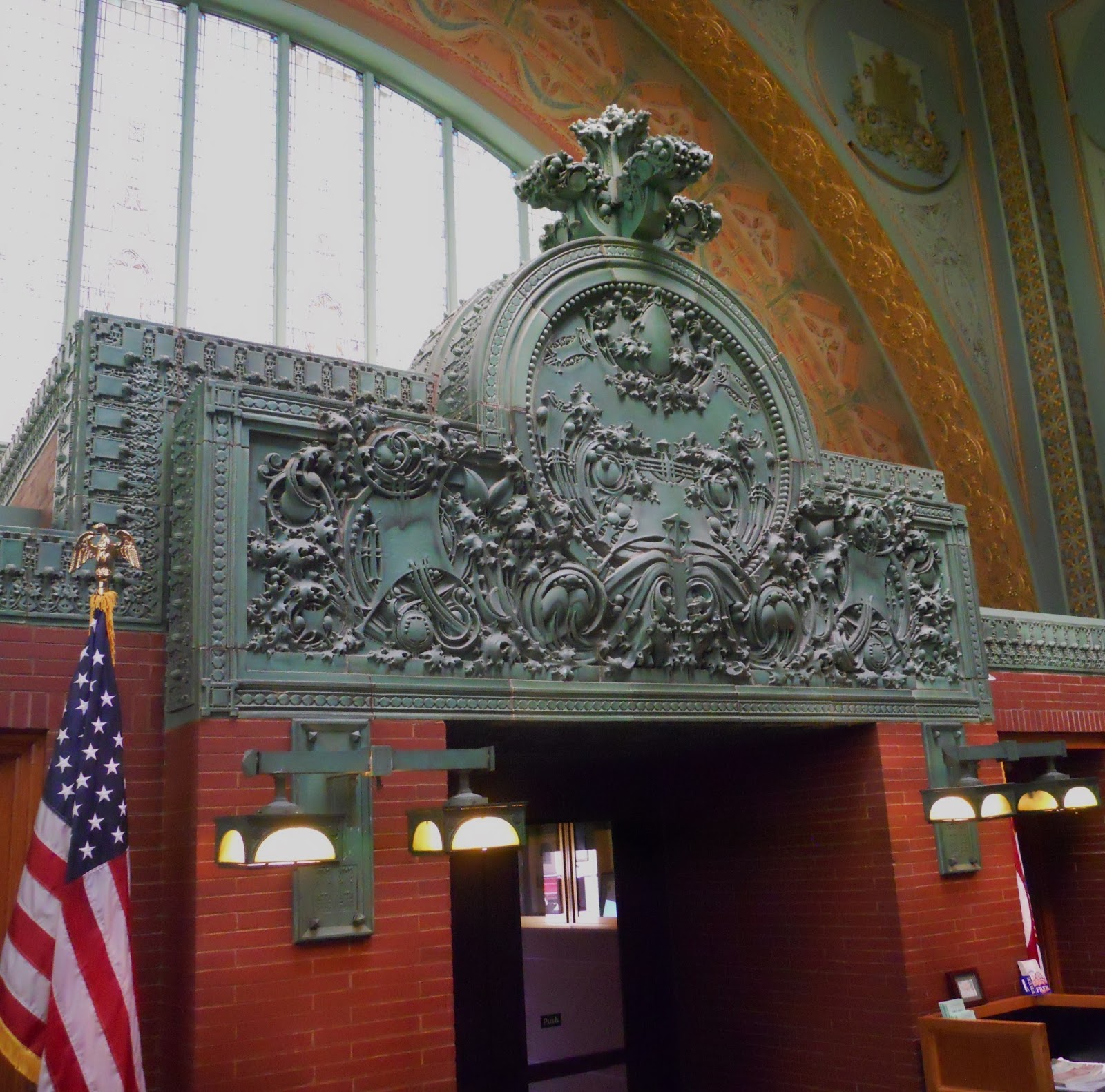
"Electoliers" weigh 2 1/2 tons each

   Because of an economic downturn in the 1890s, Sullivan's career virtually ended and his life became a financial disaster. With no more work for him in the Big City, Sullivan agreed to a few small projects like Farmers' Bank in Owatonna.

Sullivan called the building "a symphony of color and light."
   By 1922, Sullivan's wife had left him, he had succumbed to alcohol and died, poor and alone in a Chicago hotel room.  He had no money for burial, so his former pupil Frank Lloyd Wright paid for his funeral and burial in a Chicago cemetery.  Ironically, he was buried with a very plain marker a short distance away from the ornate graves he himself had designed for Chicago's elite businessmen.
   I'm wondering what the salt-of-the-earth Norwegian farmers of 1908 thought of the Owatonna Farmers' Bank when they came to town.
 
Carl Bennett lost the bank in the Crash in the 1920s.
 
It is now open as the Wells Fargo Bank and is a National Historic Landmark.


Friday, June 28, 2013

It might be time to clean the rain gutter when...


Maple trees are starting to grow!
But wait, there was a reason to delay:
 
Yes, that is a robin's nest, a great big American robin.  Usually the nest is 3 times this size.  She did hatch one nestling and he is now following her all around the yard, as big as her, hollering for food.
 
   So today was cleaning day, but a chore that should have taken a half hour developed into 2 hours because I can never pass up a chance to make things more complicated.


Since the ladder was out, I might as well cut all these branches overhanging the gutters.  Because all those leaves would eventually fall into the gutters, right?
 
Just to show you how small this nest is, here it is by my hand.  I don't know how she ever fit herself into it, or how it survived all the rain we have had this spring. 
 

Wednesday, June 26, 2013

In the garden

"Just remember, during winter, far beneath the bitter snow, that there's a seed that with the sun's love
in the spring becomes a rose."
~ Leanne Rhimes (and Bette Middler in that sad movie, The Rose)
Prairie Rose


   My wild Prairie Rose bush only blooms now and then, but when it does, it delivers dozens and dozens of roses that scent the whole yard.  This is, happily, "one of those" years. The bush is 5 feet tall and covered with buds from top to bottom.


   Each bloom lasts only a day, and within a week, all will be gone.  But, oh, what a glorious week that is!
  

Tuesday, June 25, 2013

And the winner is . . . .

"Awesome up your life.  Live worth writing about. "


Rainy night in March near Covent Garden
   Back to London in the fall! 

   Who picks a B&B because it has a beautiful cat, an old Lab, and a lovely garden WITH CHICKENS IN IT?
 
   Yup, me.  
 
   Hoping to meet up with a friend from Scotland and a brand new friend from London. 


Sunday, June 23, 2013

Slow Down and Enjoy the Anteater


"Sculpture and paintings have the effect of teaching us manners and abolishing hurry."  Ralph Waldo Emerson


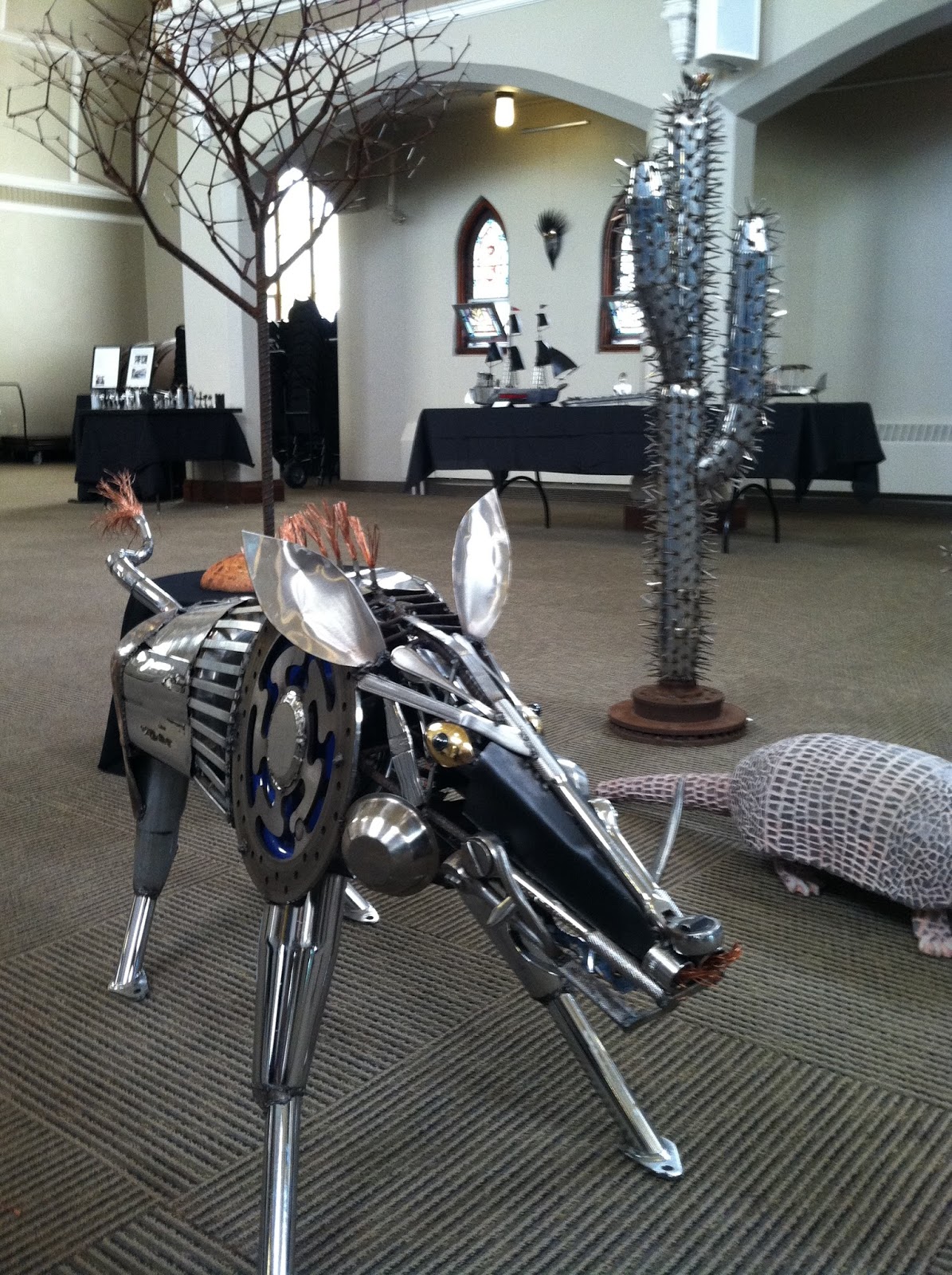
   I am fortunate to live in an area where sculpture can be found, if you know where to look for it. Yesterday it was just a couple miles away, in the small town I live nearest to, at the Steeple Center, by a local artist, Dale Lewis. 
 
   The Steeple Center is the only old building remaining in the town, and it's pretty much a miracle that it hasn't been torn down. The church was abandonned a couple years ago. Funds were scarce to save it and make the necessary repairs that would allow it to meet codes and remain in use. It would have been so sad not to see the old steeple above anything on the landscape anymore.


   The artist, Dale Lewis, creates delightful things from found objects. I found the sculptures whimsical, surprising, and would love to discover them in a garden or park.


These are my photos from the exhibit, but you can see lots more of Dale's work at
picasaweb.google.com/artistdalelewis