Thursday, June 4, 2015

Swallow-Tailed Kite

We were coming home from town today at lunchtime and saw this magnificent bird soaring gracefully at the edge of a woods, hunting. It's a Swallow-tailed kite, an endangered species that has lost 75 percent of its breeding habitat over the years as more and more land on the coast is developed for homes. There are only 120 breeding pairs left in South Carolina. And we saw one!

The photo is from the IBC birding site and the kite is holding s bat in its talons.

The kite has a wing span of four feet and 10-inch tail feathers. It is an accipiter, a hawk.

When we looked up the bird on line we found out that since they are endangered, they are being studied and we made a report on our sighting. At the end of the breeding season, we will receive information on the findings of the study.


I am excited because this is a life bird for me. And that doesn't happen often when you've been birding for half a century! I think a celebration is in order!


Wednesday, June 3, 2015

Along for the Ride

Paul played golf Saturday and I rode along in the cart as it is a beautiful course with fine views and lots of wildlife.


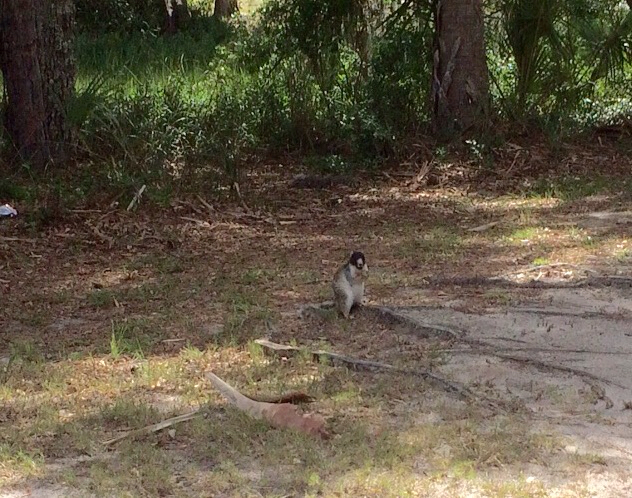
That included these guys, masked-face fox squirrels, which I'd never seen before. They look like a gray squirrel on steroids, big, muscular squirrels with black and white faces.

Locally they are called raccoon squirrels because the markings on their faces are reminiscent of raccoons.

They do look strange because they are so big for a squirrel.


We don't have holly or Spanish moss Up North. Contrary to what some people think, it gets nothing from the tree it hangs on and does not kill it. It gets everything it needs from sunlight, rainwater and air.

It's a bromeliad, related to the pineapple!

I'm looking forward to having our own holly berries to decorate with a Christmas time.


A wood stork and three turtles made a serene picture on the bank until a cormorant zoomed in. In an instant they scattered, the cormorant dove and went under the water, and there was nobody left on the bank.


One of the many beautiful views out over the water with Hilton Head Island on the horizon.


Sunday, May 31, 2015

A Roll Through the Woods

Friday was a such a gorgeous day we couldn't stay inside. We decided to borrow a golf cart and head off on a trail through the piney woods across the road.


Sadly the piney woods is scheduled to be cut for timber any day but for now it is home to many creatures -- deer, raccoons, and birds.

But that's what it was grown for, sale of the timber, and the creatures will have to adapt.


There is a primitive road through the sand, past an old abandoned pig farm and another farm with a very curious horse In a pasture. I don't imagine he sees many visitors back in here.


We came out into the open on the other side where once rice grew as far as the eye can see on vast plantations. The things that look like rocks in the mud are oyster beds. Did you know you can't eat oysters in the months that don't have an "r" in them?

Oysters spawn during the summer and spawning takes a lot of energy. To get enough energy oysters use what is stored in their bodies, leaving a not very appetizing mushy oyster instead of a fat, juicy one. Yuk. (Well, in all honesty oysters are yucky to me even when they're plump.)


This is pluff mud, what's left at low tide in the tidal flats and grassy salt marshes. It's slippery, shiny brown-gray, sucky mud and it has a nice earthy smell all its own.


And here is our destination: the old trestle bridge, now a fishing pier on the Coosawatchie River. It's a magic spot where you can feel the presence of history: Revolutionary War soldiers, plantation slaves working in the steaming hot rice fields, an old steam locomotive laboring to pull cars loaded with rice and cotton up to the markets of Charleston.


From the pier you can see all the way to Beaufort. The low spot on the horizon in the center of the river is the bridge in Beaufort 20-some miles away.


We had lunch at a locally favorite barbecue restaurant. It is only open three days a week and when it is, cars fill the parking lot. Everything is southern fried and the menu never changes. Here, I'll show you my plate.


Starting at 10 o'clock: pork with a choice of hot or mild barbecue sauce, fried chicken liver, fried gizzard, fried okra, hush puppy, homemade potato chips, potato salad, coleslaw, and plenty of dill pickles. If you want to make a sandwich of of your pork, or you need a slice of (soft, white) bread to mop up your juice, there is a communal loaf on the longest table. Just help yourself!


Paul got a stomach ache that lasted all afternoon.

The fried okra and potato chips were delicious and I ate enough to last me quite a while.

And I won't be trying the gizzards and lizards, oops livers, again. But at least I can say I did!


Tuesday, May 26, 2015

Sprucing Up the Yard

We used the holiday weekend to tend to a few projects in the yard.


Birdfeeders must be hung.


The trick here is placing them so the squirrels have limited access and the people can see them from various vantage points on the deck and screened porch.


Yes, that's about right (although the we did make some adjustments after this photo was taken).

By the end of the three-day weekend, I had logged 15 species of birds without moving from the deck!


Birdbath must be leveled.


Look at that view!

If I were a bird, I'd sit in it all day.


Except for the lavender waiting to go in the ground, the deck plants are all in pots and growing like crazy. They are on the deck to keep the raccoons and deer from munching on them at night.


Three are tomatoes, peppers, sage, pineapple sage, parsley, thyme, and sweet basil. Both tomato plants have tomatoes on them.


Clearing a spot for raised beds and a fenced area for the main garden.

The big tree came down in a storm while we were in Minnesota. Fortunately it fell away from the house!

It was a popular dining spot for the pileated woodpeckers and other woodpeckers that live here and I'm sure they are missing it.

Paul is 6 feet tall. The base of the tree where it broke off just below ground level is taller than he is. It's a monster, beautiful colors and now a base for many interesting spider webs.

We didn't just work all weekend, though. I met some of the neighbors when we were invited to a picnic featuring boiled shrimp -- possibly my most favorite food! Besides the humans, I got to meet the roosters that wake up the sun every morning, and their harem of egg layers.

******

I started my first class through FutureLearn, "World War 1: Trauma and Memory," this week. So far, it's excellent! The videos are short, well done, and very interesting, but my favorite thing is the discussion. Because students come from many countries, generations, and areas of interest and expertise, I am learning so much from them. The first video showed some of the horrible wounds and made me wonder if I wanted to continue, but I definitely do.

As a retired teacher, it's fun to be on the other side of the desk for a change!

If you're interested, go here: https://www.futurelearn.com/about. It's free and they have a big variety of classes in different areas of interest.


Saturday, May 23, 2015

One Week In My New Home

Last Saturday morning I was waking up in a strange place. A week later, it's beginning to feel like home, at least a little bit. We had a couple days in the 90sF with 95% humidity that left me feeling like a pool of melted butter, but we have also had some beautiful days and nights in the 60s and 70s, too.


I love these little fruit and veg stands along the road that appear everywhere, especially on weekends. Can you believe it, local peaches, watermelons, and tomatoes already?


This one was in front of a thrift store on the highway near Ridgeland, the closest town to where I live.


Ridgeland was first called Gopher Hill after the Gopher tortoises that live here. We saw one in the yard Thursday, lumbering along. They are about 10 inches long, live up to 60 years, and build underground tunnels 40 feet long with their powerful digging legs. I was too excited to get a photo of the one in the yard. This sculpture is in pretty little park in town.

Ridgeland was later renamed for its place on a ridge between Charleston and Savannah.


We live on an island on a tiny little road in a typical Lowcountry house, with sandy soil and trees, deer and raccoons, birdsong all day long, and Spanish moss swaying in the trees. The deck is a few yards off the water and the tides bring in lots of feeding water birds. And every night the sky is a different painting in progress. It's mesmerizing to watch and a great place to be retired and have time to do that!


Wednesday, May 20, 2015

Heading South - Day Three

The last night on the road was an "interesting" one. We found a chain of motels that accepted cats and since the first night was okay, we booked the same for the second night. Everything was fine until 2:30 a.m. when the toilet overflowed, flooding the bathroom. Their solution: we could move to another room! Dig Rosie out from behind the bed, dress, pack up, make several trips up and down stairs, undress, go back to sleep? I don't think so!

We packed up and left.

Our sightseeing stop for the day was Chattanooga, Tennessee, to see "Passages," a memorial to the Cherokee Indians forced out of their lands in 1838.

A result of "gold fever" and desire for expansion westward, the US government declared that Native Americans east of the Mississippi needed to be removed, forced out of their homes, farms, and lands, in spite of treaties that had previously made the Cherokee and their lands an independent nation. The Indian Removal Act was signed by President Andrew Jackson, whom the Cherokees had known only as a friend, in 1830.


The sad exodus from their homelands became known as "The Trail of Tears." The Cherokee were rounded up in the summer of 1838 and loaded onto boats that traveled the Tennessee, Ohio, Mississippi and Arkansas Rivers, then held in prison camps while they waited to begin the 2,200 mile walk west into Indian Territory in Oklahoma.


Four thousand of the 15,000 men and women, babies and the elderly, died from hunger, exposure, and exhaustion before they reached their destination, Indian Territory in Oklahoma.


The top of the memorial


The memorial itself was rather disappointing. Apparently it had been altered (for safety?) as the photos on the Internet showed water cascading down the steps and the walkway, with people walking through and even sitting on the steps, symbolizing the flowing tears of the Cherokee.


Cherokee

"May this statue serve to honor the countless generations of Native Americans who for thousands of years lived in this place."


We can only hope so!


And a couple funny signs from the road ...


In case you can't see it, the sign says "Daily Bread Food Pantry, open Thursday and Saturday."

And finally ... HOME!

And here is my newest friend.

Rosie wouldn't eat or drink for four days, but she is on the mend now and venturing out from under the couch at night. It won't be long before she is queen of the house, I'm sure!


Monday, May 18, 2015

Heading South - Day Two

Most of the second day on the road was rainy but it didn't matter because we were just driving anyway.


The new bridge in St. Louis, Missouri was beautiful, even in the rain. It's the 3rd largest suspension bridge in the United States and opened a year or so ago.


By the time we got to Paducah, Kentucky for a sightseeing stop, the rain had disappeared. Paducah is a fine old southern city with most of its beautiful downtown buildings still intact and occupied. Twenty blocks are listed on the National Register of Historical Places, happily protected forever.

The riverfront on the Ohio River is still bustling with river barge traffic and the streets are lively with traffic and people.


An arts program that brought local artists into emptying historic buildings is now a model program for other US cities. In 1996 a huge mural project was begun by Louisiana artist Robert Dafford on the floodwall along the levee protecting the city. More than 50 paintings cover several city blocks and depict the rich history of the town.


We absolutely loved it!


Here are a few of the 50 scenes.

Most of the panels were painted from photographs and the detail is wonderful. It was our favorite stop on the way south and we were wishing we could spend the weekend there. The Natinal Quilt Museum is incentive enough for me to return someday!